Year
2025 - On going
Theme
Thesis MIT _ Adaptive Reuse of Oil Pipelines for Ecological and Social Regeneration
Category
Territorial Design & Research
Location
Petrochemical network system, US

Introduction
Reimagining Pipeline Corridors as Ecological and Civic Frameworks
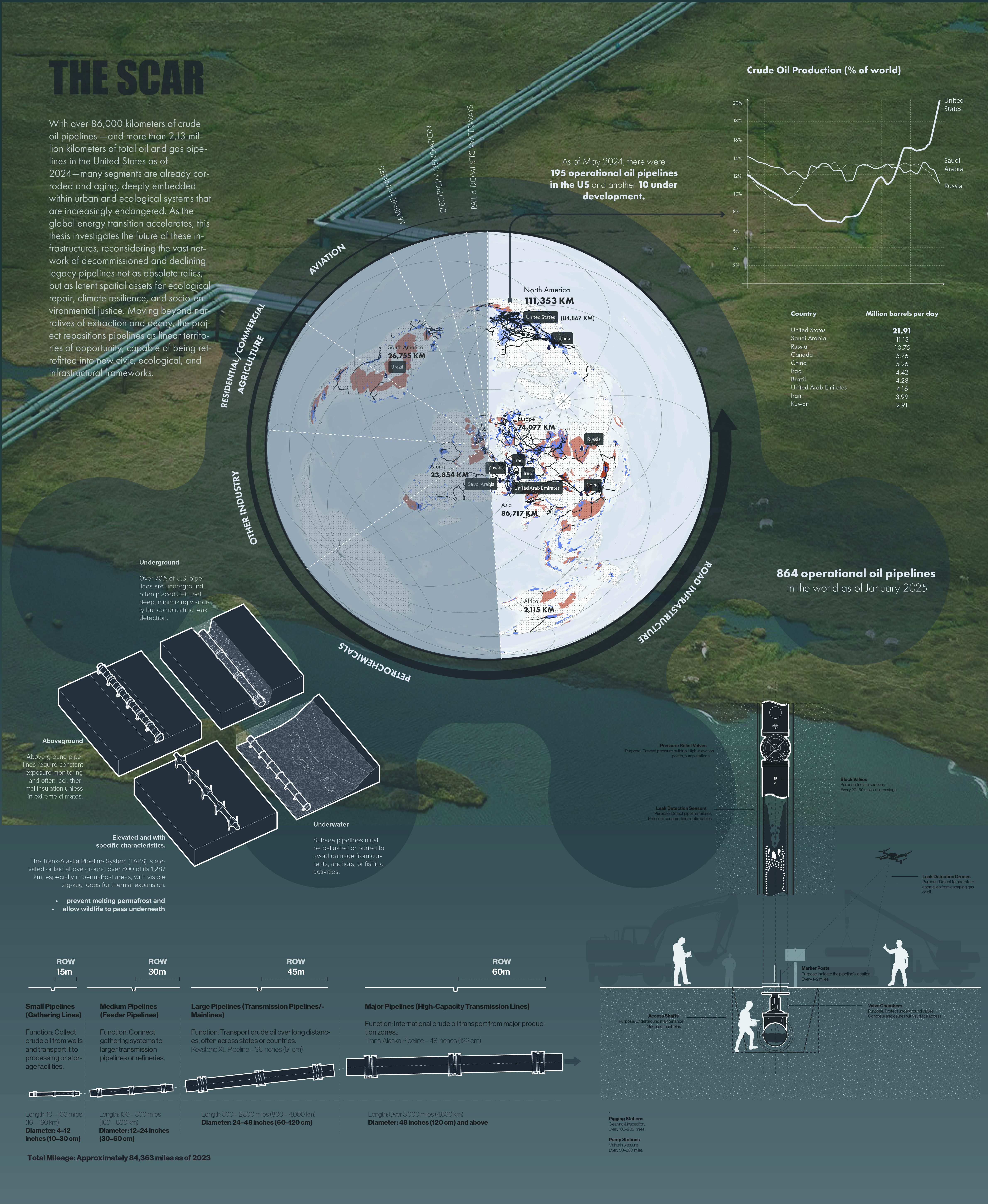
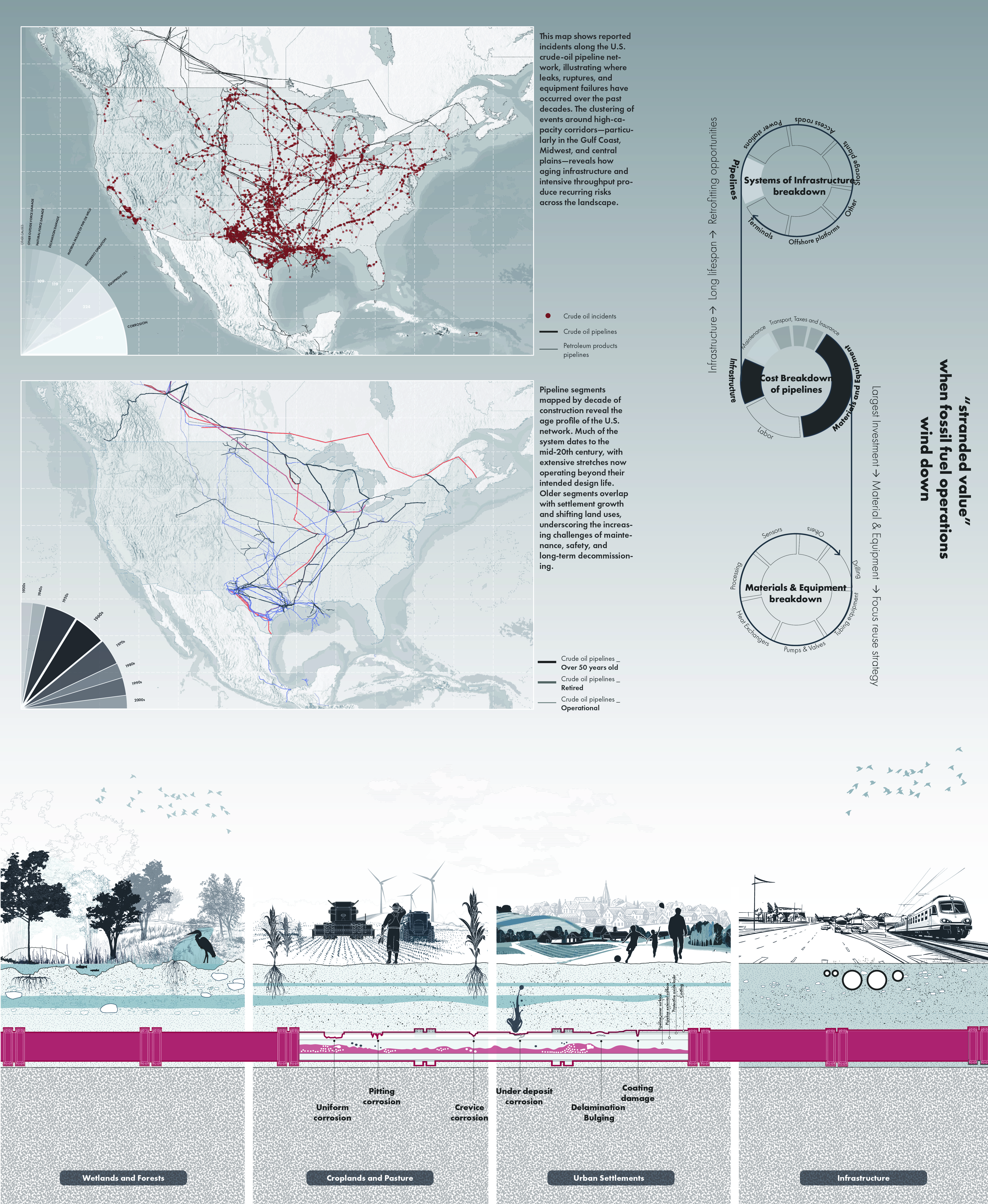
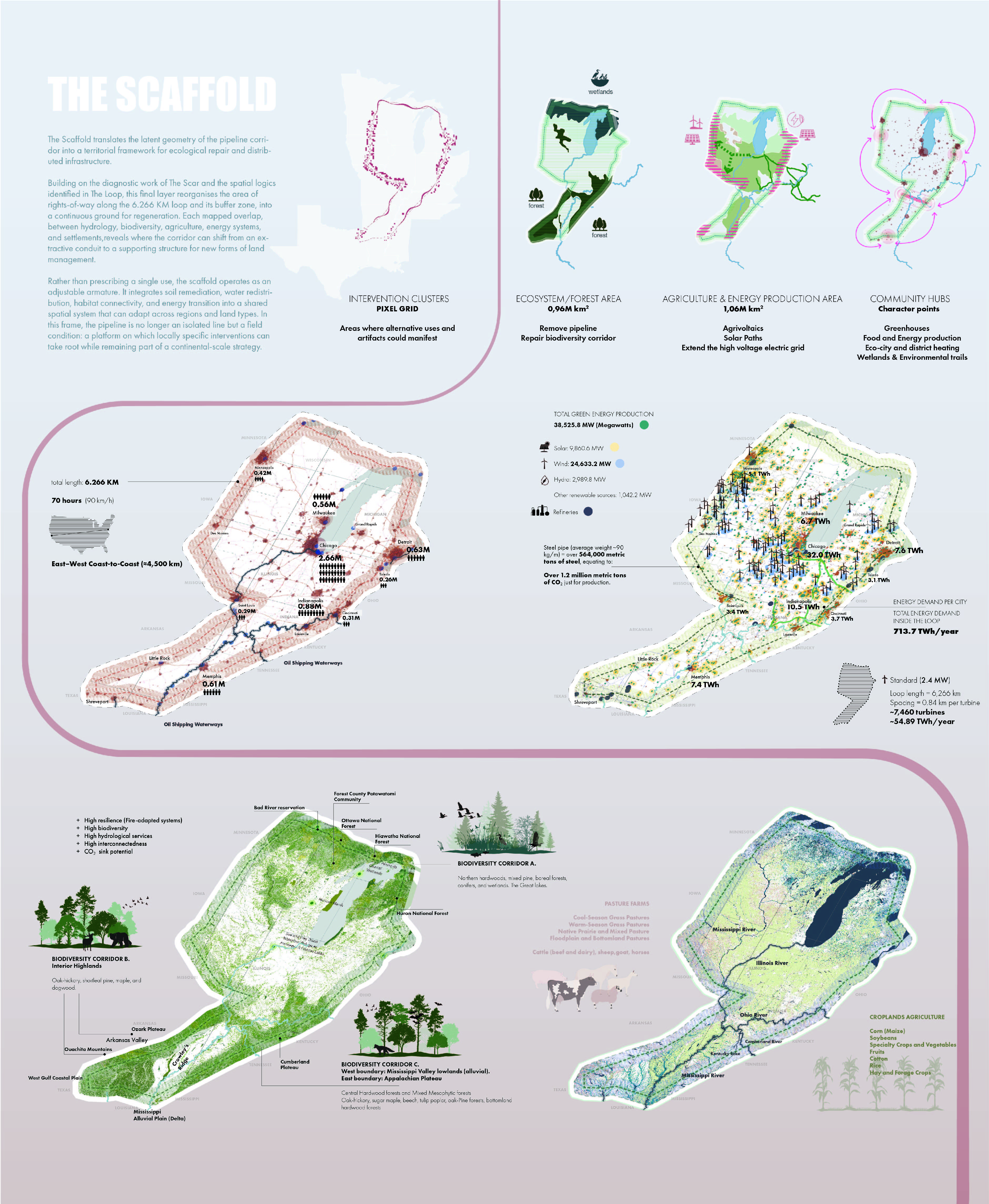
With more than 800,000 kilometers of crude oil pipelines across the United States, many corridors are approaching obsolescence as energy systems transition and infrastructures age. Rather than treating these systems as stranded remnants of extraction, From Scar to Scaffold investigates how pipeline corridors can support new ecological, civic, and territorial futures. The project approaches pipelines not as isolated technical objects, but as spatial systems embedded within wetlands, agricultural landscapes, energy infrastructures, urban territories, and ecological networks. Through mapping incidents, ageing infrastructures, energy corridors, and environmental exposure, the work reveals how pipelines continue to shape land, ecology, settlement, and resource distribution long after construction. Situated within broader histories of extraction, industrialization, and ecological fragmentation, the corridor emerges not only as a technical network, but as a spatial condition capable of supporting new forms of environmental continuity and collective inhabitation.
Challanges
From Linear Infrastructure to Territorial Continuity
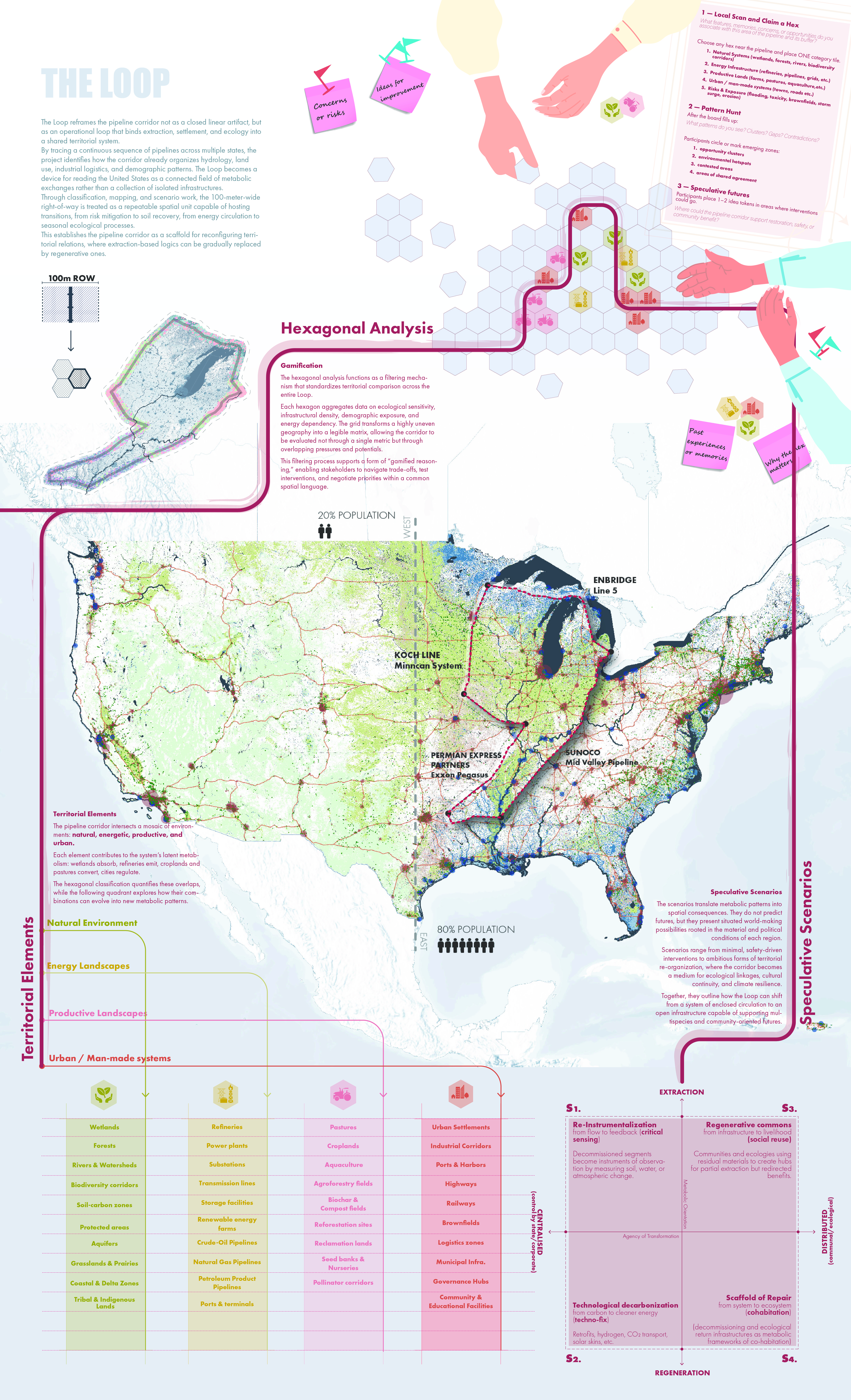
One of the project’s central challenges lies in transforming fragmented and ageing infrastructures into systems capable of supporting ecological and civic futures across territorial scales. Existing pipeline corridors operate through highly dispersed geographies shaped by overlapping environmental, infrastructural, political, and logistical conditions. The work follows the movement from scar - loop - scaffold, a way of sensing how a linear imprint becomes a continuity, and how that continuity might one day support forms of repair. The project responds by reassembling fragmented pipeline segments (6,266 kilometers of existing oil corridors) into a continuous territorial figure: the loop. Constructed through adjacency rather than geometric completion, the loop reconnects dispersed corridors into a larger spatial framework capable of supporting circulation, ecological succession, mobility, and public access. Within its band, a mosaic of soils, wetlands, croplands, energy infrastructures, and urban edges reveals how deeply pipelines are woven into the country’s environmental and social fabric. Hexagonal territorial analysis evaluates relationships between energy systems, biodiversity, hydrology, land use, urbanization, and environmental sensitivity across the corridor. Through this framework, the pipeline shifts from a singular conduit of extraction into a distributed territorial armature capable of accommodating multiple ecological and civic programs simultaneously.
Final thoughts
Toward Regenerative Territorial Infrastructures
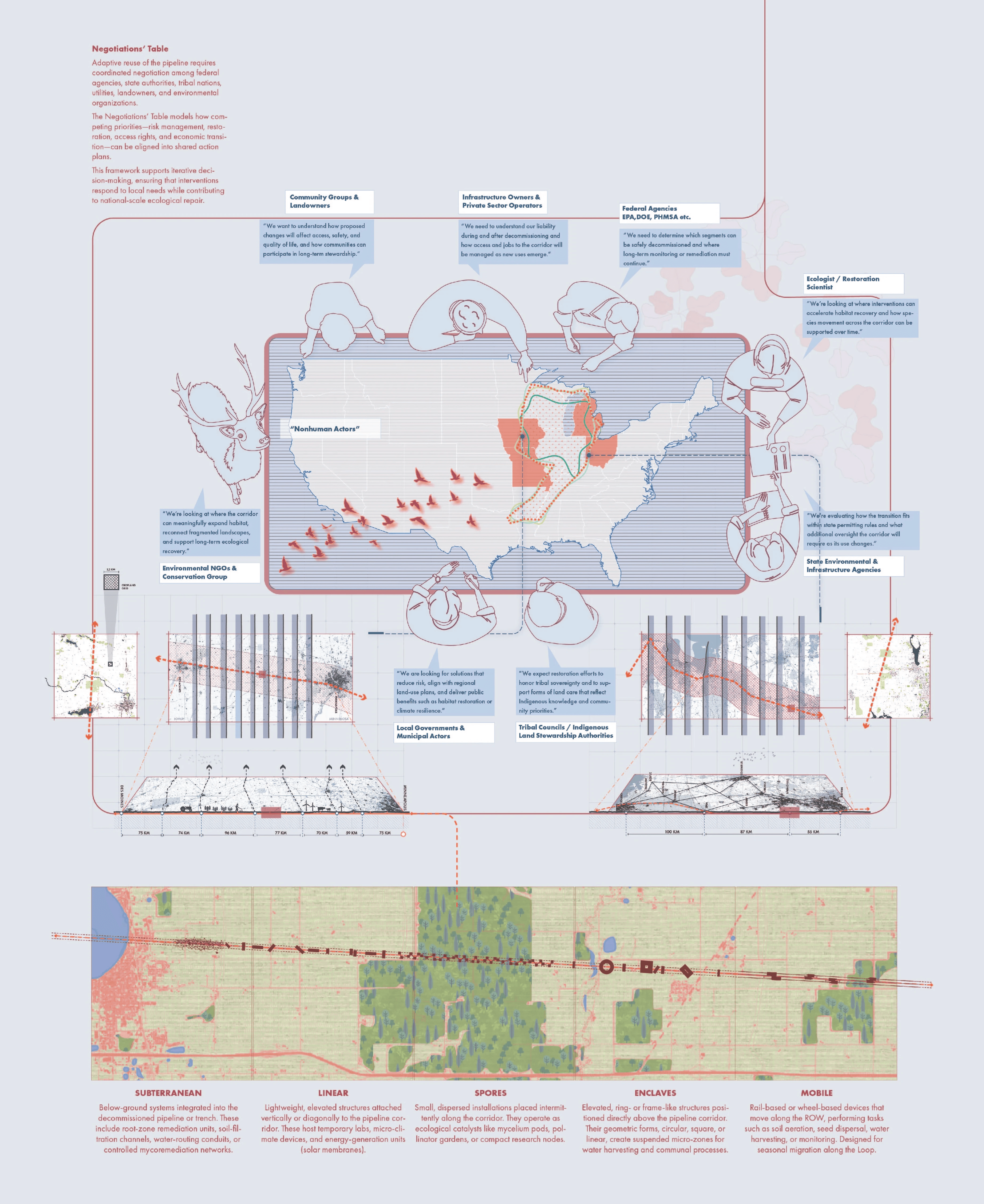
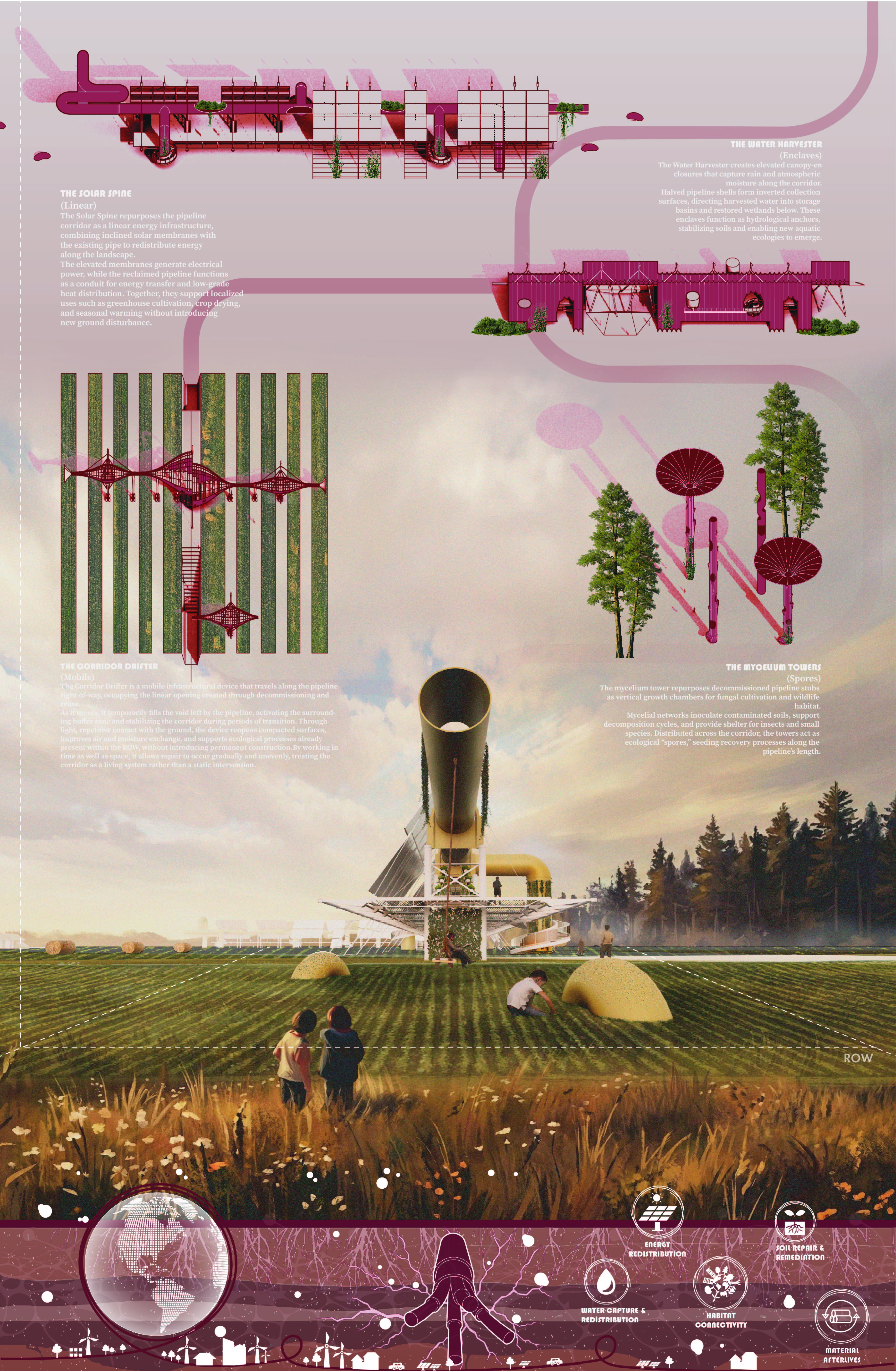
Rather than erasing industrial systems or preserving them as static relics, From Scar to Scaffold explores how ageing infrastructures can evolve into living support systems embedded within broader territorial ecologies. The project proposes a family of adaptive devices, landscapes, and spatial interventions integrated within the pipeline corridor. These interventions operate less as monumental architectural objects and more as lightweight territorial agents responding to environmental and infrastructural conditions through restoration, maintenance, water harvesting, habitat formation, and ecological succession. Together, they establish a flexible framework capable of evolving over time through participation, environmental feedback, and collective stewardship. The corridor becomes less a fixed piece of infrastructure and more an adaptive territorial scaffold capable of supporting new relationships between ecology, infrastructure, and public life in a decarbonizing world.
(03)
PROJECTS